Indian Village Directory - Explore Villages Across India
India is a country of villages. Millions of people live in rural communities spread across thousands of villages, each with its own identity, administrative boundaries, history, culture, and local institutions.
Yet finding reliable information about an Indian village is often surprisingly difficult. A person may know the name of a village but still struggle to find out which state, district, tehsil or taluka, block, gram panchayat, or PIN code it belongs to.
An Indian Village Directory brings this information together in a structured and searchable format, making it easier to explore rural India village by village.
What Is an Indian Village Directory?
An Indian Village Directory is a structured database or online directory containing information about villages across India.
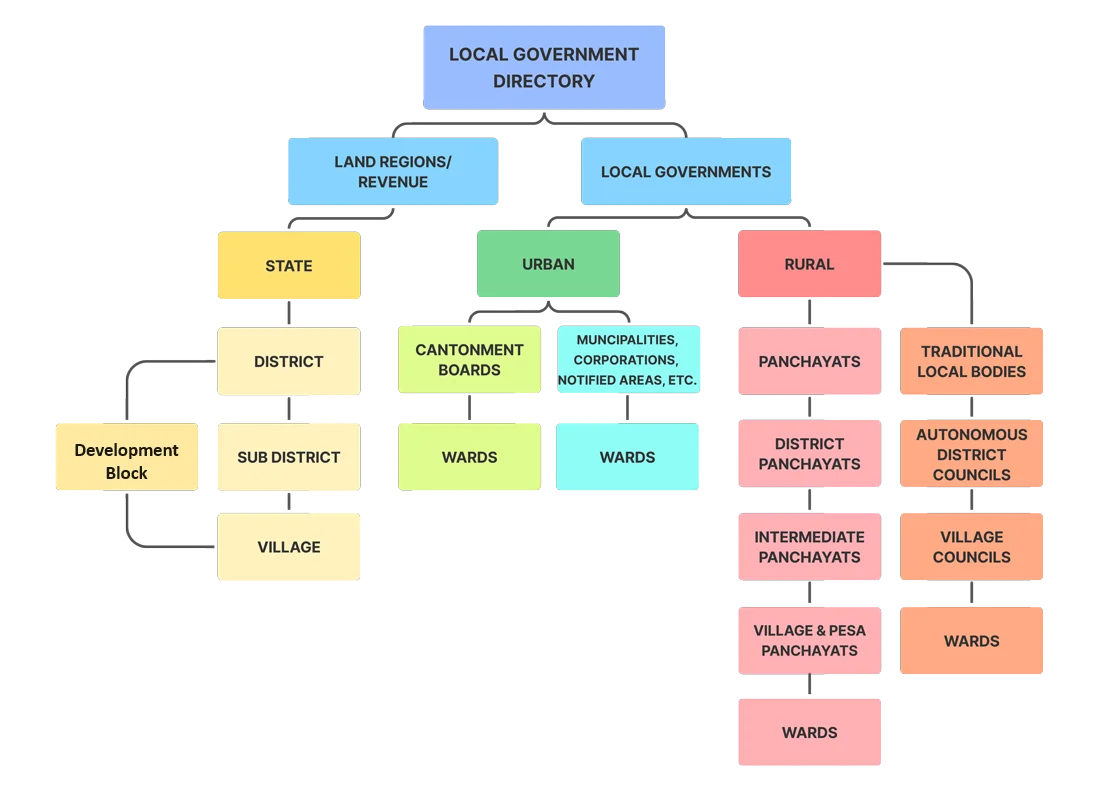
Village information can be organized through administrative levels such as:
State → District → Sub-District → Village
Depending on the data available, a village directory may also connect villages with their Gram Panchayat, PIN code, wards, census information, geographical location, and local services.
In simple terms, an Indian Village Directory works like a digital address book for rural India, helping people discover and understand villages through searchable location and administrative information.
Explore Villages by State and District
India has a vast and diverse rural landscape. Organizing villages by administrative location makes it easier to find a particular village.
A typical village directory can provide navigation such as:
- State
- District
- Sub-District / Tehsil / Taluka
- Block
- Gram Panchayat
- Village
For example, someone searching for a village in Maharashtra could start with the state, select a district, choose a taluka or sub-district, and then browse the villages associated with that administrative area.
This hierarchical structure makes large-scale village data easier to search, browse, and understand.
The Administrative Structure Behind Every Village
Understanding India's rural administrative structure is important when working with village data.
A simplified geographical hierarchy can be represented as:
State → District → Sub-District → Village
Alongside this administrative structure is the Panchayati Raj system, through which rural local self-government operates.
A simplified local-government relationship can be represented as:
Gram Panchayat → Village / Villages → Wards
A Gram Panchayat may serve a single village or multiple villages, depending on the state and local administrative arrangements.
Because of this, the relationship between a village and its Gram Panchayat is an important part of a useful village directory.
What Information Can a Village Directory Provide?
A comprehensive village profile can contain much more than just a village name.
1. Village Identity and Location
Basic information may include:
- Official village name
- Alternate or locally used names
- State
- District
- Sub-district, tehsil, or taluka
- Development block, where applicable
- Gram Panchayat
- PIN code
- Latitude and longitude
- Map location
This information helps distinguish villages that have the same or similar names.
2. Population and Census Information
Where official data is available, a village profile can include demographic information such as:
- Population
- Number of households
- Male and female population
- Sex ratio
- Literacy
- Scheduled Caste population
- Scheduled Tribe population
- Population by census year
Historical census data can also help researchers understand how a village and its population have changed over time.
3. Gram Panchayat and Local Governance
A village directory can connect a village with its local governance structure, including:
- Gram Panchayat name
- Panchayat code
- Village-to-GP mapping
- Ward information
- Local-body type
- Administrative codes
This is particularly useful when village boundaries and Panchayat jurisdictions do not follow simple one-village-to-one-Panchayat relationships.
4. Postal Information
Postal information is another important part of village identification.
A directory may provide:
- PIN code
- Post office name
- Branch or delivery office
- Postal district
- Related villages served by a post office
A single PIN code may cover several villages and post offices, so postal information should be treated as a separate layer rather than assuming every village has a unique PIN code.
5. Education and Public Services
Depending on the available datasets, village profiles can be extended with information about local facilities and services, such as:
- Schools
- Anganwadi centres
- Health facilities
- Banks
- ATMs
- Common Service Centres (CSCs)
- Post offices
- Public transport
- Other government services
Bringing these datasets together can make a village directory much more useful for citizens and researchers.
Why Is an Indian Village Directory Important?
A searchable village directory can serve many different purposes.
For Citizens
People often need basic information about a village for everyday administrative, educational, or personal reasons.
For example, a resident may want to verify:
- The district or sub-district of a village
- Its Gram Panchayat
- PIN code
- Nearby post office
- Administrative codes
- Location on a map
A well-organized directory provides a convenient starting point for finding this information.
For Students and Researchers
Village-level data is valuable for research in areas such as:
- Population studies
- Rural development
- Geography
- Sociology
- Agriculture
- Education
- Public infrastructure
- Local governance
Researchers can combine village information with census and administrative datasets to study differences between regions and communities.
For Journalists
Journalists frequently need to identify the exact administrative location of a village when reporting on local events, development projects, elections, infrastructure, or public issues.
A directory can help establish the relationship between a village and its wider administrative area.
For NGOs and Development Organizations
Organizations working in rural areas can use village-level information to better understand the areas they serve.
Combining village locations with information about schools, health facilities, roads, banking access, and other services can help identify areas that may require additional attention.
For People Tracing Their Ancestral Villages
For families living in other parts of India or abroad, finding an ancestral village can be challenging when names have different spellings.
A directory that supports alternate names, administrative relationships, and historical information can make it easier to identify the correct village.
The Challenge of Building a Village Directory
Creating a reliable Indian Village Directory is not simply a matter of collecting village names.
India's administrative geography is complex and continuously changes.
Some common challenges include:
Duplicate Village Names
The same village name can occur in multiple districts and states. Searching only by name can therefore produce ambiguous results.
A better system combines the village name with administrative information such as state, district, and sub-district.
Different Spellings and Local Names
A village may appear under different spellings in different sources.
English transliteration, regional-language spellings, historical names, and locally used names can all create variations.
Supporting alternate names improves discoverability.
Administrative Changes
Villages and local-government areas can be affected by administrative changes, including:
- Renaming
- Merging
- Splitting
- Changes in district boundaries
- Changes in sub-district boundaries
- Changes in Gram Panchayat jurisdiction
A village directory therefore needs mechanisms for handling historical and current administrative relationships.
Different Data Sources
Village information may come from different government departments and datasets.
Examples include data associated with:
- Census of India
- Ministry of Panchayati Raj
- State government departments
- Local bodies
- India Post
- Other public datasets
These sources may use different codes, naming conventions, and administrative definitions. Carefully matching and validating records is essential.
A Village Directory Should Be Living Data
A useful village directory should not be treated as a one-time list.
Administrative boundaries change. Local bodies are reorganized. New public facilities are established. Postal information can change. New official datasets are released.
For this reason, a modern village directory should be continuously reviewed and updated wherever reliable new information becomes available.
Historical data is also valuable. Rather than replacing older records completely, a good system can preserve historical information while clearly distinguishing it from current administrative data.
Local Knowledge Makes Village Data Better
Official datasets provide an essential foundation, but local residents can provide valuable information that may not appear in formal databases.
Community contributions can help identify:
- Alternate village names
- Local landmarks
- Historical information
- Cultural sites
- Important local places
- Incorrect or outdated information
A responsible contribution system can allow residents to suggest corrections while keeping official data clearly distinguished from community-submitted information.
Building a Digital Map of Rural India
An Indian Village Directory can become more than a searchable list of names.
When village information is connected with maps, administrative boundaries, Panchayat data, postal information, census statistics, public facilities, and local knowledge, it becomes a powerful platform for exploring rural India.
Users can move from a country-level view to a state, district, sub-district, Gram Panchayat, and finally an individual village.
This makes India's enormous rural landscape easier to discover and understand digitally.
Frequently Asked Questions
What is an Indian Village Directory?
An Indian Village Directory is a structured database or online resource that provides searchable information about villages across India, including their administrative location and other available details.
How are Indian villages organized?
Villages can generally be explored through administrative levels such as State → District → Sub-District → Village. Villages may also be associated with Gram Panchayats and local wards.
Can I search for a village by name?
Yes. A village directory can allow users to search by village name and narrow the results using state, district, sub-district, or other administrative information.
Can two villages have the same name?
Yes. Identical or similar village names can occur in different parts of India. Administrative information is therefore important for identifying the correct village.
What information can I find about an Indian village?
Depending on the available data, a village profile may include its name, state, district, sub-district, Gram Panchayat, PIN code, location, population, census information, wards, and public services.
Is every village associated with a separate Gram Panchayat?
No. A Gram Panchayat may serve one village or multiple villages, depending on the applicable administrative structure.
Why is village-level data important?
Village-level data supports citizens, researchers, journalists, government agencies, NGOs, students, and others who need detailed information about India's rural communities.
Conclusion
India's villages are an essential part of the country's geography, economy, culture, and social fabric. Yet finding accurate and organized information about an individual village can still be difficult when data is distributed across different sources.
An Indian Village Directory helps bridge that gap by organizing village information into a searchable structure.
Leave a Comment (0)
No comments yet
Be the first to comment!